
Regulation (EU) 2021/664 created Europe’s first harmonised regulatory framework for the U-space. Adopted on 22 April 2021 and applicable from 26 January 2023, it establishes how unmanned aircraft can operate safely in designated volumes of airspace where the density or nature of traffic requires a digitally enabled service layer.
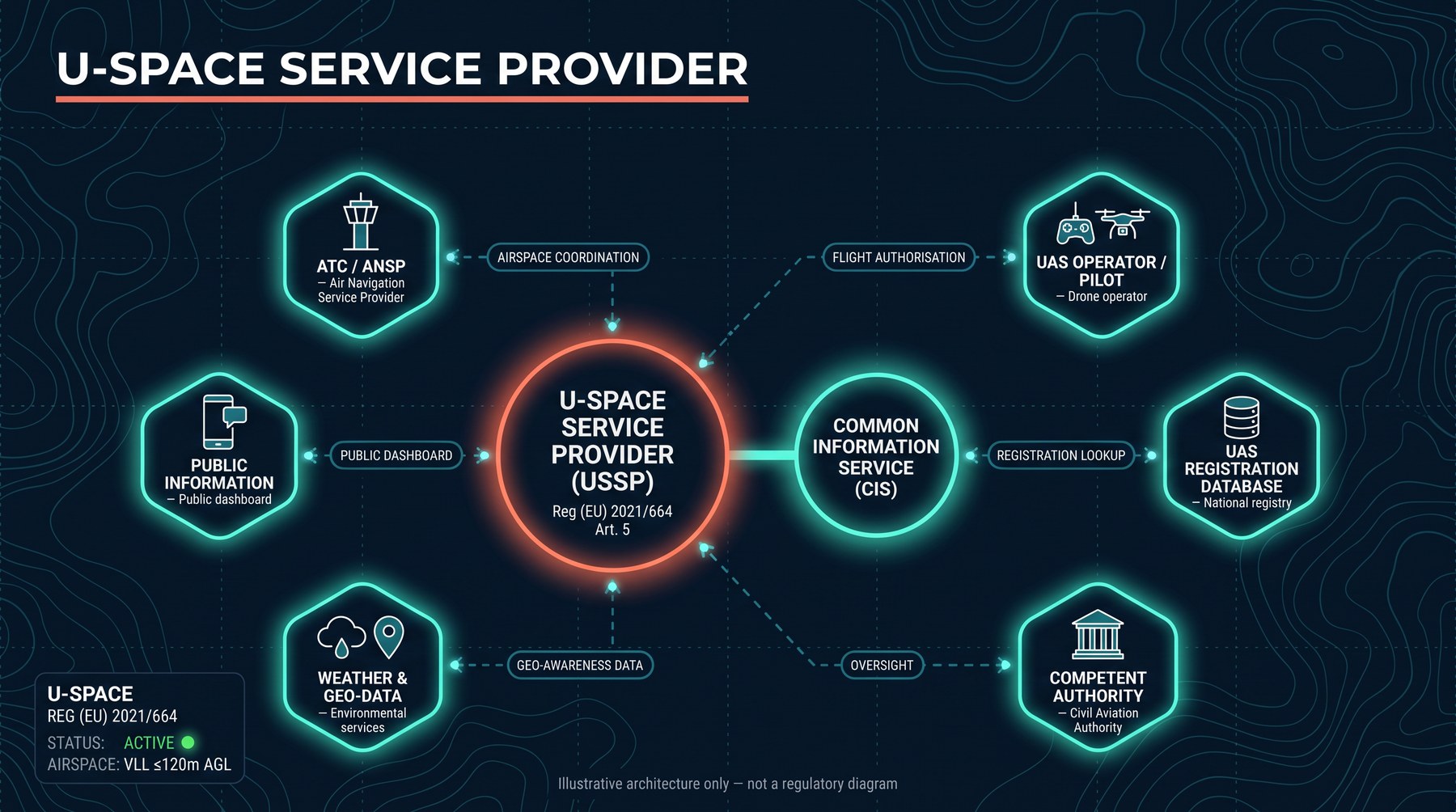
U-space is not a single regulation but a package. 2021/664 is the core implementing rule; it is accompanied by Regulation (EU) 2021/665, which amends 2017/373 to set out how air traffic service providers coordinate with U-space, and Regulation (EU) 2021/666, which amends the rules of the air. Read together, they define the obligations of UAS operators, U-space service providers (USSPs) and the providers of the common information service (CIS).
- 2021/664
- Regulatory framework for the U-space
- +665 / +666
- ATS coordination & rules of the air
- Applicable
- 26 January 2023
Regulatory scope
The Regulation applies wherever a Member State designates U-space airspace. Within such a volume, UAS operators must be equipped to use, and must subscribe to, the mandatory U-space services provided by a certified USSP. The framework deliberately separates the digital service provision (USSPs and CIS) from the traditional manned-aviation control structure, while requiring rigorous coordination at the boundary between the two.
Key articles and annexes
Article 3 establishes U-space airspace and the obligation to define capabilities, performance requirements, operational conditions and airspace constraints (detailed in Annex I). Article 5 sets out the common information service and the data to be made available (Annexes II and III). Articles 7 and 8 define the mandatory U-space services — network identification, geo-awareness, UAS flight authorisation and traffic information — and the supporting services such as weather and conformance monitoring. Article 14 governs the certification of USSPs, with the certificate template at Annex VI. Critically, Annex V specifies the exchange of operational data between USSPs and air traffic service providers, which is where AVISU’s ATS heritage is most valuable.
- Annex I — criteria for UAS and U-space service performance, operational conditions and airspace constraints
- Annex II–III — common information and data quality, latency and protection requirements
- Annex V — operational data exchange between USSPs and ATS providers
- Annex VI — the USSP certificate
What compliance demands
Before any U-space airspace can be established, the Member State must complete an airspace risk assessment that determines which services and constraints are required. USSPs must then be certified against the organisational and service requirements of the Regulation, demonstrating data quality, latency, security and a sound safety management system. For UAS operators, compliance means correct equipage, subscription to services and adherence to the flight-authorisation process. The hardest engineering and safety challenge is the interface with manned aviation: the dynamic and static reconfiguration of airspace, and the data exchange under Annex V, must be designed so that unmanned operations never erode the safety of conventional traffic.
How AVISU helps
AVISU bridges the two worlds U-space must connect — established air traffic management and the new unmanned ecosystem. Our work on the SaxaVord airspace change proposal demonstrates exactly this capability.
- U-space airspace risk assessment and the supporting safety case to underpin a Member State designation.
- Airspace change proposals integrating U-space and conventional traffic, including the UK CAA CAP1616 process.
- USSP certification readiness against the organisational and service requirements of 2021/664.
- Design of the ATS–USSP coordination and data-exchange interface under Annex V and Regulation 2021/665.
- Concept of Operations development and AVISIM-based traffic and capacity analysis.
- Stakeholder and regulator engagement throughout the approval lifecycle.